• Skip to primary navigation
  • Skip to main content
  • Skip to footer
Inter-Narratives Community

Inter-Narratives Community

  • Library
  • Sessions
  • Priorities
  • About
  • Subscribe

Insight

Library

Every two weeks we send out a newsletter full of narrative ideas and resources. We’ve catalogued these ideas by theme and category, which you can search below:


Emerging Opportunities to Shift Culture On Health, Wealth and Government

Theme: Climate & Ecology, Economy, Social Justice

Narrative work type: Framing, Insight, Narrative Strategy

New research, which included a “first-of-its-kind survey”, reveals six “key findings about the state of British culture – and what this could mean for those of us working to change culture nationwide.” The findings in brief are: “1. Individualism is our default – but not when we get issue-specific; 2. Precarity is seen as our new normal – and people support bold action on extreme wealth; 3. More of us believe the economy is rigged; 4. We see health as a national resource; 5. Politicians are seen as ‘not like us’; 6. Some mindsets cluster together, with major implications for social change work.” The final finding suggests that coordinated effort by actors working on different issues to move one “lynchpin mindset” can maximise collective impact with a “positive spillover effect.”

Author: Jennifer John, Tamsyn Hyatt; Frameworks UK: Moving Mindsets

Understanding Authoritarianism: Resources to Defend Democracy

Theme: Culture change, Reactionary, Social Justice

Narrative work type: Infrastructure, Insight, Tactics

“Today, almost 40 percent of the world’s population live in countries where democracy is deteriorating; a sharp increase in the last ten years; 80 percent of the global population lives in countries or territories rated not free or only partly free; and the trend of democratic erosion shows no signs of slowing down… This resource library is a curated collection of articles, essays, tools, and analyses designed to help you understand the roots, tactics, and impacts of authoritarian movements. But knowledge is only the first step. These resources are meant to empower educators, organisers, students, and everyday people with the insight and language needed to challenge authoritarianism, stand up for democracy, and build a world of belonging without othering. Whether you’re just beginning to learn or seeking deeper context to take action, you’ll find resources here to inform, connect, and inspire.”

Author: Miriam Juan-Torres González; Othering & Belonging Institute

Shattered Britain

Theme: Climate & Ecology, Culture change, Economy, Social Justice

Narrative work type: Insight

The latest update to the ‘seven segments’ of the British population, charting where they’re at across a set of ‘drivers’, ‘fault lines’, their views on Immigration, Economics, and Climate, Politics, and the media they consume. The well-known segments receive a fresh taxonomy and distribution, as the political picture evolves, offering “a look upstream not just at what different groups think, but why they think it.” The four ‘drivers’ are “A crisis of trust; Exhaustion and struggle; Rising threat perception and a Loss of agency”. The ‘fault lines’ that help explain the division in Britain: “Appetite for change and risk; Simple or complex solutions; Individual agency; Conspiratorial thinking and ‘finding my own truth’; Multiculturalism and identity; Social disconnection; Attitudes towards free speech; The importance of identity.” There is also a webinar.

Author: More In Common

Who are Reform UK’s ‘Red’ and ‘Blue’ Voters? Part 2

Theme: Economy, Reactionary, Social Justice

Narrative work type: Insight

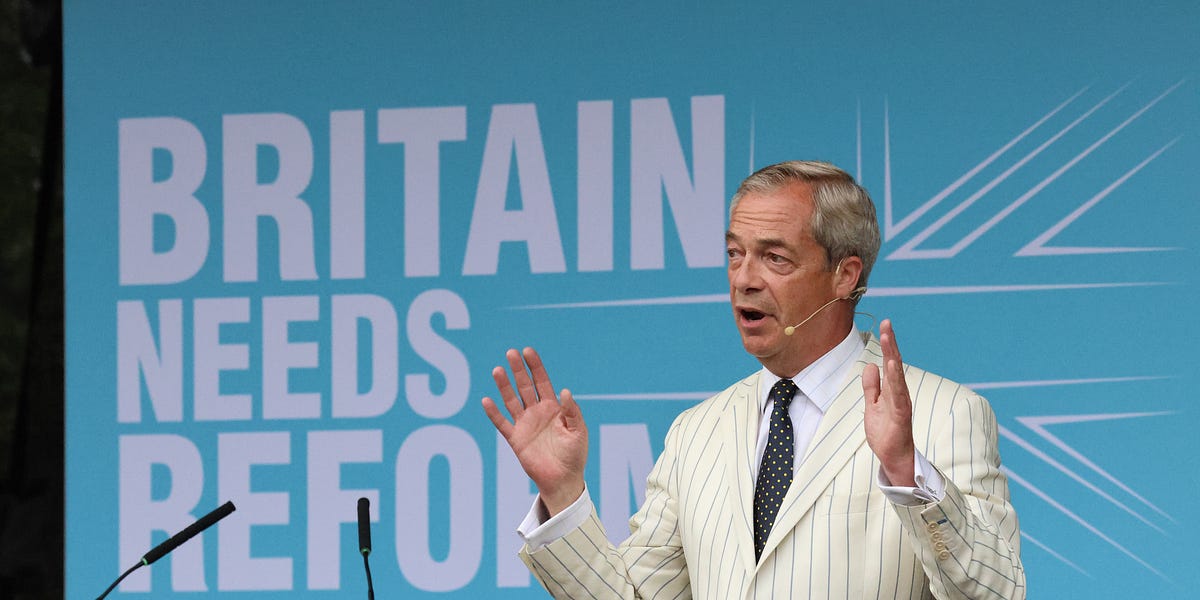
Following on from part 1, we learn of the two key factors driving support for Reform: voters are “more likely than not to think the country is getting worse, and more likely than not to feel disrespected.” Just 3 in 10 Reform voters say they feel respected, and 95% of Reform UK supporters believe Britain is in decline – which is “significantly out of step with the broader public”. 92% believe that “politicians don’t listen to people like me” and overall “tend to express economically populist sentiments, broadly agreeing that the economy is structured in a way that doesn’t benefit ordinary people,” with 74% “thinking big businesses take advantage of ordinary people” and 78% saying “rich people are able to get around the law more easily” – which explains why Reform are “positioning themselves as the party of domestic ‘family capital’, rather than national and international capital”.

Author: Unchecked UK; Populism Unpacked

What Messages Might Reform be Vulnerable To?

Theme: Economy, Reactionary, Social Justice

Narrative work type: Framing, Insight, Narrative Strategy

Echoing a finding above, new research suggests that “by far the most impactful” message, when attempting to persuade Reform voters away from Reform, was a ‘corporate interests’ message “highlighting the money that Reform has taken from different interest groups, oil and gas especially, to question Farage’s motivations.” This message “pushed down not just on favourability to Farage, it was the only message to significantly reduce willingness to vote for Reform. It decreased Farage’s numbers as best PM, increasing Starmer’s lead over him in the two-way version of this question.” Overall we are reminded that “Reform is strong when the conflicts in British politics are cultural. They are potentially weaker, and Labour stronger, when the conflicts are economic.” The recommendation? Go “centre on culture (safe and unspectacular), and left on economics…actively seeking conflict and attention on the latter to raise its salience – especially as it relates to voters’ cost of living concerns.”

Author: Steve Akehurst; Strong Message Here

Variations in Climate Opinions Across the United Kingdom

Theme: Climate & Ecology

Narrative work type: Insight

A new interactive mapping tool that “depicts public climate change beliefs, risk perceptions, policy support, experiences, and attribution beliefs across the UK.” It finds that “a very large majority of adults in the UK think climate change is happening (85%) and human-caused (74%), but many also perceive climate change as a relatively distant threat…only 55% think it will harm them personally.” Also the use of renewable energy for electricity, fuel, and heating is very popular across the UK (80%), and polarisation is much lower than in the US, with 2/3 thinking climate change should be a priority for government. The maps also reinforce the earlier finding that “direct exposure to extreme weather does not automatically translate into stronger belief that climate change affects these events. Rather, when appropriate, communicators need to help people ‘connect the dots’ between climate change and extreme events, drawing on the findings of attribution science.”

Author: Yale Programme on Climate Communications

Who Are Reform UK’s ‘Red’ and ‘Blue’ Voters?

Theme: Climate & Ecology, Culture change, Economy, Social Justice

Narrative work type: Insight

Insight from a new initiative that aims to “act as a repository of insights and practical advice” for those who are acting on the challenge of the rise of deceptive right-wing populism in the UK. “This is the first release of our three-part series on Reform UK’s voter coalition — who are they, what do they think about regulation, and most importantly, how can progressives do a better job of reaching them?” They find that “although Reform UK – and UKIP before it – have often been depicted as a party of older, small-state, Brexit-supporting voters, this view is simplistic and increasingly outdated. In reality, the party draws together a much more complex coalition… this analysis aims to inform the strategic choices of progressive campaigners seeking to engage, persuade, or contest these voters, particularly those of us making the case for strong social and environmental protections.”

Author: Populism Unpacked; Unchecked UK

Overcoming Fatalism

Theme: Climate & Ecology, Culture change, Economy, Social Justice

Narrative work type: Insight, Narrative Strategy, Tactics

“When governments fail to address wealth inequality, cost of living crises, and collapsing public services, it provides fertile conditions for fatalism to grow.” Referencing research from FrameWorks, Boait reflects on how “decades of cultural individualism have left people unreceptive to ideas rooted in universalist principles; indeed, collectivist mindsets have been so weakened in the UK that any form of collectivism can now easily be seen as a threat,” and how “when collectivism is perceived as a threat, strongmen like Farage appeal by promising to protect people based on their individual identities.” They caution that “whilst messaging is critical, countering fatalism fundamentally requires moving people out of a ‘fear’ mindset, since research shows that fear and anger can reduce people’s sense of agency.” Which means listening to people, activating curiosity, and demonstrating, with honesty and humility “that we are all holding uncertainty together, but that through that uncertainty we can still find shared purpose for collective change.”

Author: Fran Boait; Renewal

On Our Lives with the News

Theme: Climate & Ecology, Culture change, Economy, Social Justice

Narrative work type: Framing, Insight

A reflection on how mainstream news media has become so negative and unhelpful, and a suggestion for what to do now. Bornstein’s main recommendation, as a way to "make goodness as riveting as evil" is to engage people with curiosity. Because "we're wired to pay attention to threats, but we're also wired to love puzzles." So he suggests that we tell positive "How dunnit?" stories that present some positive event – a success in government or institutions, in the way that business is typically covered in the media, rather than just the failures – framed in a way that encourages people to be curious about how the success was achieved. For example: "how did this school actually increase the high school graduation rate when all the other schools with similar resources haven't been able to figure that one out?" They also explore a ‘Hippocratic Oath for Journalism’, which seeks to make media “radically helpful”.

Author: David Bornstein, Krista Tippett; On Being

The Fightback Against Reform

Theme: Culture change, Election29, Philanthropy

Narrative work type: Insight, Narrative Strategy

A “deliberately provocative” assessment of the “much deeper malaise” beneath Reform’s rise: “a loss of faith in the future”, enabled by civil society’s failure to respond with a suitably uplifting vision. Evans lists four reasons for this failure: the “professionalisation of so much of civil society”; the Charity Commission’s insistence on funders being ‘apolitical’; funders themselves being risk-averse and short-term; and those civil society professionals’ disconnection from the majority. “We so often end up deepening divisions in a way that helps the populist right, instead of bridging divides and building the broader coalitions that we so urgently need.” This piece tees up a second part that will explore the “incredible points of light out there that we can learn from and build from,” which can help us all see “a positive, people-powered insurgency: one that brings us together instead of dividing us, that fires us up with a sense of possibility and purpose, and that enables us to build a brighter future together.”

Author: Alex Evans; The Good Apocalypse Guide

Mainstream Economics is not Sustainable

Theme: Climate & Ecology, Economy, Social Justice

Narrative work type: Framing, Insight

A brief summary of four essays by the Tipping Point podcast host, delivered by a post-growth economist, which suggest that mainstream economics is neither socially nor economically sustainable. Wilkins suggest seven actions to get beyond this, some of which are particularly relevant for narrative change work: “4. Take back the narrative: economics is about wellbeing, resilience and regeneration; 6. Insist, as citizens, on political and business accountability and media focus on progress on wider indicators, including the genuine progress indicator, the human development index, wellbeing economy frameworks and planetary boundaries.” They suggest that “if you work in sustainability, these essays are essential reading. They’ll help you understand the system that’s been holding back your work – perhaps your life's work – and give you language to push back.”

Author: Jennifer Wilkins, Katy Shields; LinkedIn

The Rise Of End Times Fascism

Theme: Climate & Ecology, Culture change, Economy, Social Justice

Narrative work type: Deep narrative, Insight, Narrative Strategy, Tactics

A clear-eyed systemic analysis of "rightwing leaders and their rich allies" who have "bought into various apartheid fantasies of bunkered safety" and are "choosing to let the Earth burn" with a “darkly festive fatalism”. Two recommendations for moving forward: 1. "Understand this simple fact: we are up against an ideology that has given up not only on the premise and promise of liberal democracy but on the liveability of our shared world – on its beauty, on its people, on our children, on other species.” And 2. "Counter their apocalyptic narratives with a far better story about how to survive the hard times ahead without leaving anyone behind. A story capable of draining end times fascism of its gothic power and galvanising a movement ready to put it all on the line for our collective survival. A story not of end times, but of better times; not of separation and supremacy, but of interdependence and belonging; not of escaping, but staying put and staying faithful to the troubled earthly reality in which we are enmeshed and bound."

Author: Naomi Klein, Astra Taylor; The Guardian

  • Page 1
  • Page 2
  • Page 3
  • Interim pages omitted …
  • Page 13
  • Go to Next Page »

Footer

Get the latest narrative insights, collected and delivered to your inbox, every two weeks

SUBSCRIBE

Questions, comments, or suggestions? Contact us

We are supported by:

The JJ Charitable Trust

Calouste Gulbenkian Foundation

  • Privacy Policy
We use cookies on our website. By clicking “Accept”, you consent to the use of the cookies.
Accept
Read our privacy policy for more details.
Manage consent

Privacy Overview

This website uses cookies to improve your experience while you navigate through the website. Out of these, the cookies that are categorized as necessary are stored on your browser as they are essential for the working of basic functionalities of the website. We also use third-party cookies that help us analyze and understand how you use this website. These cookies will be stored in your browser only with your consent. You also have the option to opt-out of these cookies. But opting out of some of these cookies may affect your browsing experience.
Necessary
Always Enabled
Necessary cookies are absolutely essential for the website to function properly. These cookies ensure basic functionalities and security features of the website, anonymously.
CookieDurationDescription
cookielawinfo-checkbox-analytics11 monthsThis cookie is set by GDPR Cookie Consent plugin. The cookie is used to store the user consent for the cookies in the category "Analytics".
cookielawinfo-checkbox-functional11 monthsThe cookie is set by GDPR cookie consent to record the user consent for the cookies in the category "Functional".
cookielawinfo-checkbox-necessary11 monthsThis cookie is set by GDPR Cookie Consent plugin. The cookies is used to store the user consent for the cookies in the category "Necessary".
cookielawinfo-checkbox-others11 monthsThis cookie is set by GDPR Cookie Consent plugin. The cookie is used to store the user consent for the cookies in the category "Other.
cookielawinfo-checkbox-performance11 monthsThis cookie is set by GDPR Cookie Consent plugin. The cookie is used to store the user consent for the cookies in the category "Performance".
viewed_cookie_policy11 monthsThe cookie is set by the GDPR Cookie Consent plugin and is used to store whether or not user has consented to the use of cookies. It does not store any personal data.
Functional
Functional cookies help to perform certain functionalities like sharing the content of the website on social media platforms, collect feedbacks, and other third-party features.
Performance
Performance cookies are used to understand and analyze the key performance indexes of the website which helps in delivering a better user experience for the visitors.
Analytics
Analytical cookies are used to understand how visitors interact with the website. These cookies help provide information on metrics the number of visitors, bounce rate, traffic source, etc.
Advertisement
Advertisement cookies are used to provide visitors with relevant ads and marketing campaigns. These cookies track visitors across websites and collect information to provide customized ads.
Others
Other uncategorized cookies are those that are being analyzed and have not been classified into a category as yet.
SAVE & ACCEPT