• Skip to primary navigation
  • Skip to main content
  • Skip to footer
Inter-Narratives Community

Inter-Narratives Community

  • Library
  • Sessions
  • Priorities
  • About
  • Subscribe

Messaging

Library

Every two weeks we send out a newsletter full of narrative ideas and resources. We’ve catalogued these ideas by theme and category, which you can search below:


The Squeeze Out: Why Labour Is Crushing Your Living Standards

Theme: Economy, Social Justice

Narrative work type: Framing, Messaging

Through a simple and accessible explanation of the history behind why “Labour are being forced to do Austerity 2.0,” Stevenson offers a suggestion for how best to talk about wealth inequality with ordinary British people: “The Squeeze Out of the working class, The Squeeze Out of the middle class, The Squeeze Out of the government by rich people.” ‘The Squeeze Out’, Stevenson suggests, “is a really powerful way to explain to ordinary people what’s happening and how it affects them.” Our typical language: ‘wealth inequality’, “can sound academic, idealistic, egalitarian, politics of envy” whereas ‘The Squeeze Out’ focuses on “the most damaging and dangerous effect for ordinary people:” as the rich outcompete other groups in society for assets, over time, everyone else has fewer assets and more debt. There are five stages to this process, and we’re not far off the fifth now: “the rich own everything, and the only way they can grow their wealth is by sending you to fight in their wars against each other.” To stop this ‘squeeze out’: “tax wealth, not work”.

Author: Gary Stevenson; Garys Economics

Theme: Climate & Ecology

Narrative work type: Messaging, Tactics

An evidence-led reminder of how best to approach ‘Established Liberals’ when speaking to ordinary people about climate and ecological breakdown. The conclusion: “get Established Liberals, who are sensitive about their social position but are feeling a growing existential fear about the future, to feel brave enough to speak out, by showing them that others in their group share their fears and are willing to question existing social norms and systems,” with the important caveat that: “alongside this shift is a need to not tell the audience what to do via a specific call to action. Instead, offer an invitation for Established Liberals to join with others in determining shared responses that they are drawn to.” We’re also asked to consider people’s unmet needs of security, autonomy and connection, and provided with a suggestion of the ‘emotional jobs to be done’.

Author: This Is Agency, Sourcenine.

Talking Social Security

Theme: Economy, Social Justice

Narrative work type: Framing, Insight, Messaging

Thorough guidance for communicating about social security. There are ‘framing principles’, ‘key metaphors’, ‘stats that tell a story’, ‘words that work’, ‘common attacks’ and insight around ‘where the public are at’. The core message includes: “No matter what we do for a living or where we live, many of us want pretty similar things. A warm home, time with family and friends, a rewarding job. Most of all, we want to feel excited and optimistic about tomorrow, knowing we can cope with whatever life has in store. But right now, for too many of us, the future feels uncertain… The social security system should be designed to be a springboard: helping us when we want to change careers, retrain or find a job. And, at those points in all of our lives, when we need to prioritise other things, it should be there to ensure you don’t face the worry and stress of losing the things you’ve worked hard for, or have to put family, friends and your community second.”

Author: NEON

The Science of Communicating Hope

Theme: Climate & Ecology, Culture change, Economy, Social Justice

Narrative work type: Insight, Messaging, Narrative Strategy

“Anger mobilises, hope organises.” Coombes reflects on what neuroscience tells us about focusing on what’s going wrong in our stories, and becoming “more aware of how our biology might be driving our strategy…asking ourselves whether we are motivated by a desire to punish or to heal,” noticing for example that “when we witness kindness, our brain processes it as if someone is being kind to us, which in turn drives us to be kind.” Also, given that our brains are “wired to accept what is familiar… we need to shift our focus from what currently is, to showing what could be. From raising awareness to changing awareness,” which “on the most basic level, means reinforcing the idea that we are all human beings and that this identity should shape policymaking.” Stories are therefore more than just comms, they are a way to “rewire our brains and reshape our communities.”

Author: Thomas Coombes; hope-based communication

There’s No Substitute for Public Opinion

Theme: Culture change, Reactionary, Social Justice

Narrative work type: Insight, Messaging, Tactics

Insights and warnings from the last time a demagogue upended the organs of US democracy unchecked. “What will it take to make the public see Trump’s anti-democratic strategies as wrong, distasteful, and not something they want to associate themselves with?” Kleinfeld suggest two steps, first: “create a ‘vibe’ in which disagreement and dislike can surface in socially acceptable ways. For example: ‘I like Trump but I wish he hadn’t done that.’ Such vibes allow people to feel they won’t be pariahs for their opinions;” and then: “impede a realignment if the Republican Party proves willing to enable widespread anti-democratic actions.” To achieve this, “there is no substitute for a ground game of mass organizing”, as MAGA have proved. “One key lesson is building more fun into such work: a little less MSNBC and spinach, a little more YouTube and funnel cakes.” Ultimately, “if history is any guide, the democracy field needs a vast increase in its communications infrastructure and acumen, from AI and influencers to local connections and camaraderie. And it needs it now.”

Author: Rachel Kleinfeld; Persuasion

What Does Elon Musk Want?

Theme: Culture change, Economy, Social Justice

Narrative work type: Insight, Messaging, Tactics

A recent study finds that disinformation about refugees is rife, seemingly the result of reactionary attempts to falsely pin our economic woes on migrants, rather than inequality. Former top-trader turned inequality-campaigner Stevenson makes an interesting case here that this creates a problem for reactionaries: if anti-immigration parties actually deliver on their promises, then we won’t have any immigrants to point at and blame. As our conditions continue to worsen, despite lower immigration, we may then turn on the reactionaries. Which means the reactionary parties and their backers have to somehow demonise immigration, whilst actually increasing it. The Conservatives tried this in the UK, and they lost power. How will this play out elsewhere, and what can we do about it? Stevenson encourages his audience, who seem to be trapped in a zero sum winner-takes-all mindset, to recognise that “you need to change the rules of the game and that means working together.”

Author: Gary Stevenson; Gary’s Economics

Beyond The Broadcasting Model

Theme: Climate & Ecology, Culture change, Economy, Social Justice

Narrative work type: Messaging, Narrative Strategy, Tactics

“Foundations and nonprofits need to focus on community building rather than just pushing messages to an audience (or to that awful, imprecise word that ought to be banished to the jargon jar, “stakeholders”). It’s about engaging real people in meaningful ways to foster support and collaboration, which requires investing in genuine relationships and building sustainable communities based on shared values…This means moving away from mass messaging and toward face-to-face connections – listening, collaborating, and forming real partnerships… Trust is the foundation of communication, and in the field of communications-for-good, cultivating trust isn’t optional, it’s essential… Ultimately, the shift from broadcasting to relationship-building is more than just a tactical change. It’s a recalibration, driven by data and the evolving expectations of the communities we serve…we’d do well to remember that communication and community are inseparable and evolved from that common root.”

Author: Sean Gibbons, Tristan Mohabir; SSIR

How We Should be Reporting Climate Target Setbacks

Theme: Climate & Ecology

Narrative work type: Messaging

“Solutions journalism, better known in Europe as constructive journalism, is bolstered by newsroom data that shows audiences respond better to climate stories that illustrate human ingenuity, courage, and drive. These human stories largely make up the kind of news that most people actually care to consume… If we want to avoid audiences turning away from climate conversations, we need to invest in people-centred stories that we know audiences like because they find them more immediately relevant and relatable to their own lives… In practice it means reporting on how communities are finding it harder to live in healthy and fair ways, but also what people from all walks of life and all sectors are doing to fight for that sustainable future… We need to hear the human stories of the energy transition. What is working and what isn’t, how entrepreneurs, small businesses and corporations are changing their practices in recognition of the fact that British people care so deeply about climate and nature.” See an example of this kind of storytelling here.

Author: Jasmin Souesi, Tara Bryer; Climate Outreach

What Happened In France (in the Summer)?

Theme: Election24, Fascism, Social Justice

Narrative work type: Insight, Messaging, Tactics

A reflection on the snap election this summer in France, when the left-leaning alliance rallied to resist the far right with a surprise “come-back” in the second vote. This offers specific lessons for resisting fascism, e.g. “we have to cast elections against authoritarian leaders as elections that are a fork in the road for two futures – not a competition between two existing agendas.” It also describes how its success was due to a rapid coordination that centred organisers – “people who wanted to do things” – and that by working from shared goals and messaging, this coordination across movements was able to reach a lot of people quickly, inviting them in to choose “care” instead of “hatred”, with the emphasis on what they were ‘for’, rather than just ‘against’.

Author: Sarah Durieux, Anat Shenker-Osorio; NEON

Pop Culture: Bursting the Climate Communication Bubble

Theme: Climate & Ecology, Culture change

Narrative work type: Messaging, Tactics

In their whitepaper last year, New Zero World suggested that “to create a sustainable future, we must inspire the public's imagination and emotions and set out the media and creative industries’ unique abilities to captivate audiences through their superpowers of storytelling, entertainment and engagement.” One year on, they “hope to build on those insights, by providing simple, actionable frameworks and examples to empower communicators of all kinds, working across disciplines around the world to go beyond awareness raising and information sharing, and instead use culture to shape a future to fall in love with, not fear”, seeing culture as a “cheat code”, and the need for a “cultural ecosystem view” instead of a “firehose”. They conclude that “what got us here, won’t get us where we need to go”.

Author: New Zero World

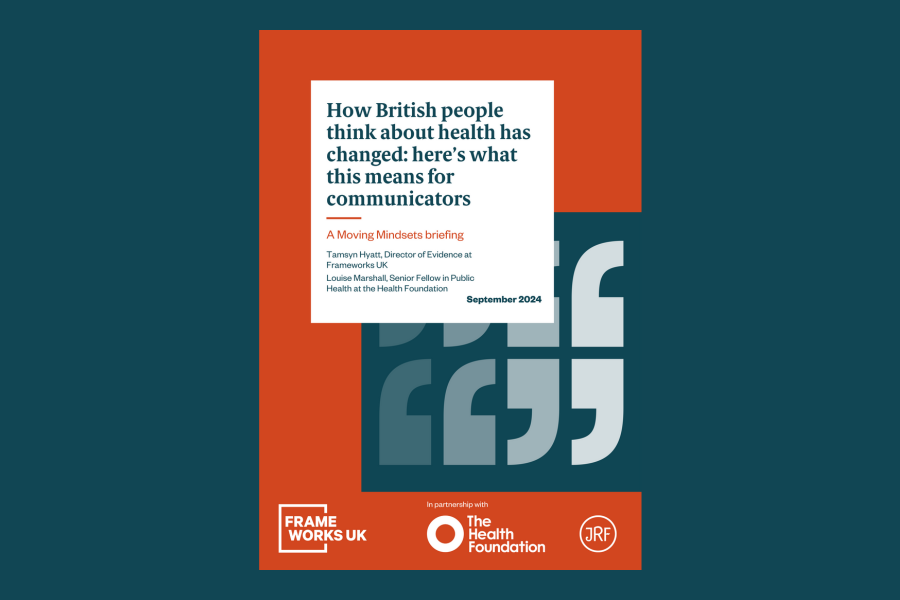
Moving Mindsets: How British People Think About Health Has Changed

Theme: Care, Climate & Ecology, Social Justice

Narrative work type: Framing, Messaging, Narrative Strategy

Reveals that “we are at an important inflection point. More collective mindsets on health are emerging and old mindsets are being applied in new, more systemic ways. Over the last six years, the way we think about health in the UK has changed.” This has implications for communicators, which are explored in detail, but in brief: “1) Position public health asks as national initiatives and needs. 2) Reinforce the idea that when all of us have what we need to be healthy, our communities thrive. 3) Use an expansive, inclusive definition of ‘nation.’” (Part of the Moving Mindsets programme)

Author: Tamsyn Hyatt, Louise Marshall; Frameworks UK

Perceptions of a Just Transition in the Built Environment

Theme: Climate & Ecology, Economy, Social Justice

Narrative work type: Insight, Messaging

“Given the significant impact of the built environment, how can we frame messaging in a way that secures broad buy-in and attracts more attention to the urgent transition needed in the sector? This report tested three distinct narratives through a large-scale poll, surveying 20,229 people across 10 European countries—the largest study of its kind on this topic. The three narratives emphasise the importance of a built environment transition in different manners: Pragmatic, Futuristic, and Insecurity. Through the poll results, these narratives are proven to significantly influence respondents' view on the topic of built environment transition.”

Author: Demos Helsinki, 89up, Laudes Foundation

  • Page 1
  • Page 2
  • Page 3
  • Interim pages omitted …
  • Page 11
  • Go to Next Page »

Footer

Get the latest narrative insights, collected and delivered to your inbox, every two weeks

SUBSCRIBE

Questions, comments, or suggestions? Contact us

We are supported by:

The JJ Charitable Trust

Calouste Gulbenkian Foundation

  • Privacy Policy
We use cookies on our website. By clicking “Accept”, you consent to the use of the cookies.
Accept
Read our privacy policy for more details.
Manage consent

Privacy Overview

This website uses cookies to improve your experience while you navigate through the website. Out of these, the cookies that are categorized as necessary are stored on your browser as they are essential for the working of basic functionalities of the website. We also use third-party cookies that help us analyze and understand how you use this website. These cookies will be stored in your browser only with your consent. You also have the option to opt-out of these cookies. But opting out of some of these cookies may affect your browsing experience.
Necessary
Always Enabled
Necessary cookies are absolutely essential for the website to function properly. These cookies ensure basic functionalities and security features of the website, anonymously.
CookieDurationDescription
cookielawinfo-checkbox-analytics11 monthsThis cookie is set by GDPR Cookie Consent plugin. The cookie is used to store the user consent for the cookies in the category "Analytics".
cookielawinfo-checkbox-functional11 monthsThe cookie is set by GDPR cookie consent to record the user consent for the cookies in the category "Functional".
cookielawinfo-checkbox-necessary11 monthsThis cookie is set by GDPR Cookie Consent plugin. The cookies is used to store the user consent for the cookies in the category "Necessary".
cookielawinfo-checkbox-others11 monthsThis cookie is set by GDPR Cookie Consent plugin. The cookie is used to store the user consent for the cookies in the category "Other.
cookielawinfo-checkbox-performance11 monthsThis cookie is set by GDPR Cookie Consent plugin. The cookie is used to store the user consent for the cookies in the category "Performance".
viewed_cookie_policy11 monthsThe cookie is set by the GDPR Cookie Consent plugin and is used to store whether or not user has consented to the use of cookies. It does not store any personal data.
Functional
Functional cookies help to perform certain functionalities like sharing the content of the website on social media platforms, collect feedbacks, and other third-party features.
Performance
Performance cookies are used to understand and analyze the key performance indexes of the website which helps in delivering a better user experience for the visitors.
Analytics
Analytical cookies are used to understand how visitors interact with the website. These cookies help provide information on metrics the number of visitors, bounce rate, traffic source, etc.
Advertisement
Advertisement cookies are used to provide visitors with relevant ads and marketing campaigns. These cookies track visitors across websites and collect information to provide customized ads.
Others
Other uncategorized cookies are those that are being analyzed and have not been classified into a category as yet.
SAVE & ACCEPT