• Skip to primary navigation
  • Skip to main content
  • Skip to footer
Inter-Narratives Community

Inter-Narratives Community

  • Library
  • Sessions
  • Priorities
  • About
  • Subscribe

Reactionary

Library

Every two weeks we send out a newsletter full of narrative ideas and resources. We’ve catalogued these ideas by theme and category, which you can search below:


Understanding Authoritarianism: Resources to Defend Democracy

Theme: Culture change, Reactionary, Social Justice

Narrative work type: Infrastructure, Insight, Tactics

“Today, almost 40 percent of the world’s population live in countries where democracy is deteriorating; a sharp increase in the last ten years; 80 percent of the global population lives in countries or territories rated not free or only partly free; and the trend of democratic erosion shows no signs of slowing down… This resource library is a curated collection of articles, essays, tools, and analyses designed to help you understand the roots, tactics, and impacts of authoritarian movements. But knowledge is only the first step. These resources are meant to empower educators, organisers, students, and everyday people with the insight and language needed to challenge authoritarianism, stand up for democracy, and build a world of belonging without othering. Whether you’re just beginning to learn or seeking deeper context to take action, you’ll find resources here to inform, connect, and inspire.”

Author: Miriam Juan-Torres González; Othering & Belonging Institute

Who are Reform UK’s ‘Red’ and ‘Blue’ Voters? Part 2

Theme: Economy, Reactionary, Social Justice

Narrative work type: Insight

Following on from part 1, we learn of the two key factors driving support for Reform: voters are “more likely than not to think the country is getting worse, and more likely than not to feel disrespected.” Just 3 in 10 Reform voters say they feel respected, and 95% of Reform UK supporters believe Britain is in decline – which is “significantly out of step with the broader public”. 92% believe that “politicians don’t listen to people like me” and overall “tend to express economically populist sentiments, broadly agreeing that the economy is structured in a way that doesn’t benefit ordinary people,” with 74% “thinking big businesses take advantage of ordinary people” and 78% saying “rich people are able to get around the law more easily” – which explains why Reform are “positioning themselves as the party of domestic ‘family capital’, rather than national and international capital”.

Author: Unchecked UK; Populism Unpacked

What Messages Might Reform be Vulnerable To?

Theme: Economy, Reactionary, Social Justice

Narrative work type: Framing, Insight, Narrative Strategy

Echoing a finding above, new research suggests that “by far the most impactful” message, when attempting to persuade Reform voters away from Reform, was a ‘corporate interests’ message “highlighting the money that Reform has taken from different interest groups, oil and gas especially, to question Farage’s motivations.” This message “pushed down not just on favourability to Farage, it was the only message to significantly reduce willingness to vote for Reform. It decreased Farage’s numbers as best PM, increasing Starmer’s lead over him in the two-way version of this question.” Overall we are reminded that “Reform is strong when the conflicts in British politics are cultural. They are potentially weaker, and Labour stronger, when the conflicts are economic.” The recommendation? Go “centre on culture (safe and unspectacular), and left on economics…actively seeking conflict and attention on the latter to raise its salience – especially as it relates to voters’ cost of living concerns.”

Author: Steve Akehurst; Strong Message Here

Shifty

Theme: Culture change, Economy, Reactionary, Social Justice

Narrative work type: Deep narrative, Issue narrative

Curtis weaves his trademark tapestry of image, sound and logic to portray a story of power in the UK, proposing a explanation of our recent political history. We explore how an “underlying pessimism about human motives”, along with a mistaken belief in the possibility of control, led Thatcher’s government and its descendants to gradually give away their power. We see this happen through often ludicrous spin and deception, the financialisation of capitalism, and the privatisation of public goods and services (a process we learn was invented, or at least expanded by the Nazis). Major events are set against a backdrop of how the population was feeling, to provide an unsettling, revealing, infuriating and always entertaining perspective on the making of this moment, and a stark observation about the nature of power today. The ending provides an honest reflection on the role of work like this in these times.

Author: Adam Curtis; BBC iPlayer

We Have Been Subverted

Theme: Climate & Ecology, Culture change, Economy, Reactionary, Social Justice

Narrative work type: Deep narrative, Insight

If you’ve been paying attention to reactionary discourse and propaganda (e.g. from ARC forum), the perspective shared here will be familiar, but it’s useful to see it so clearly laid out – and to see how the same collapse signals are leading to very different conclusions for people. Ali introduces us to the tactics of subversion, courtesy of a former KGB agent, and how they have been employed in a “systematic and totalising way” to undermine and erode Western values. She asks “who is doing the subverting, who is trying to unravel America and the West?” In her view: “American Marxists… Radical Islamists… and The Chinese Communist Party,” with Vladimir Putin “waging his own subversion campaign by supporting and advancing the three other forces.” We are warned they are “promoting ideas that weaken the bonds between members of the family, promoting narcissistic individualism over family unity, creating financial stressors that discourage family formation (and) acrimony between the sexes”, and told that “a closed society is immune to subversion because it simply tells potential subverters to leave. Free and open societies cannot rely on this defence.” Whoever it is that is actually using the tactic, ‘divide and conquer’ seems to be working.

Author: Ayaan Hirsi Ali; The Free Press

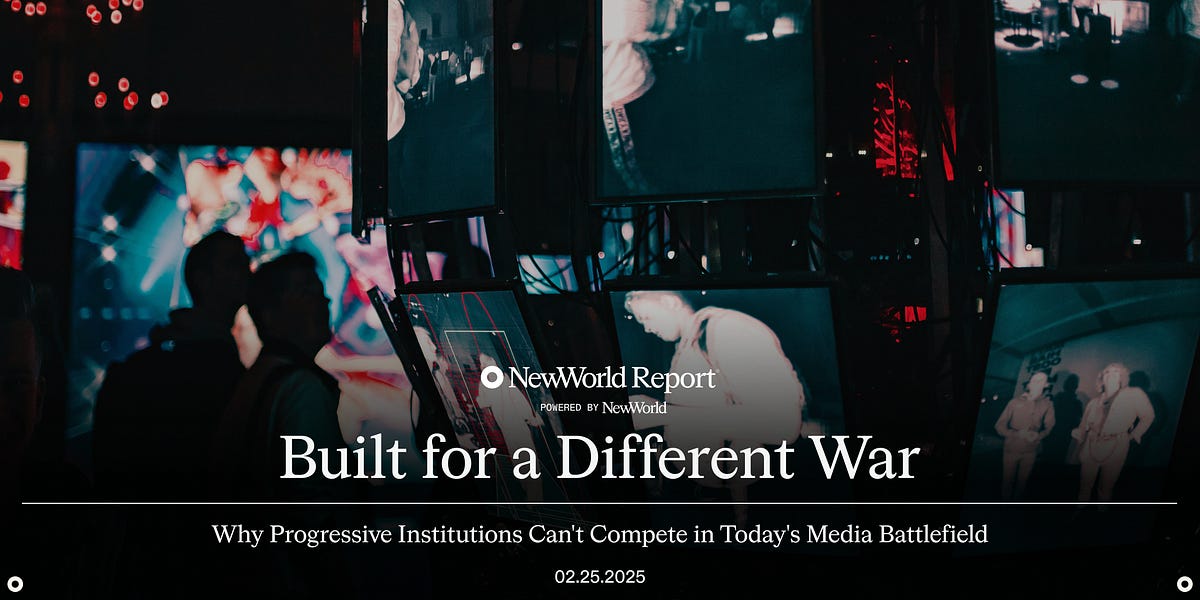
Built For a Different War

Theme: Climate & Ecology, Culture change, Economy, Election24, Philanthropy, Reactionary, Social Justice

Narrative work type: Narrative Strategy, Tactics

As the word ‘advocacy’ is banned from academic papers in the US, Banks reflects on how “the old pathways to influence are broken” with an instructive critique of progressives’ failure in “the battle for the nation’s conscience and culture”, as it continues to play by “the old rules.” “The progressive movement continues to pour resources into outdated influence tactics – broadcast advertising, performance marketing, media relations teams, policy shops, and think tanks – while the right has spent decades methodically building a sprawling ecosystem of decentralised (but powerfully coordinated) narrative infrastructure… Many progressives still think their problem is messaging: crafting the perfect slogan, landing the right talking point, tweaking the framing to be more ‘persuasive.’ But the real challenge is distribution.” Banks offers three steps for developing the essential “strategies that move the majority of people, on the platforms where they actually spend their time”.

Author: Andre Banks; New World Report

Don’t Be Fooled. They Lie as Easily as They Breathe

Theme: Climate & Ecology, Economy, Reactionary, Social Justice

Narrative work type: Framing, Insight, Tactics

On how Trump and Musk’s mission “to destroy the restraints of regulatory democracy on unfettered capitalism, wherever it may have taken root in the world,” and their “preference for unregulated markets deliberately detached from democratic institutions” makes one thing clear: “capitalism is hostile to democratic processes and institutions.” Understanding this helps us recognise how, “slowly and skilfully over the last decade, the billionaire class has worked to delegitimise the slow process by which America’s democracy has widened the net of inclusion and diversity,” by “dismantling the process of inclusion and diversity” with “the propaganda campaign labelled ‘the culture wars’ — in reality a war between capital and labour.” A lesson for us: stop “actively negating the ‘culture wars’ framing” and instead celebrate “the wider democratic advance.”

Author: Ann Pettifor; System Change

There’s No Substitute for Public Opinion

Theme: Culture change, Reactionary, Social Justice

Narrative work type: Insight, Messaging, Tactics

Insights and warnings from the last time a demagogue upended the organs of US democracy unchecked. “What will it take to make the public see Trump’s anti-democratic strategies as wrong, distasteful, and not something they want to associate themselves with?” Kleinfeld suggest two steps, first: “create a ‘vibe’ in which disagreement and dislike can surface in socially acceptable ways. For example: ‘I like Trump but I wish he hadn’t done that.’ Such vibes allow people to feel they won’t be pariahs for their opinions;” and then: “impede a realignment if the Republican Party proves willing to enable widespread anti-democratic actions.” To achieve this, “there is no substitute for a ground game of mass organizing”, as MAGA have proved. “One key lesson is building more fun into such work: a little less MSNBC and spinach, a little more YouTube and funnel cakes.” Ultimately, “if history is any guide, the democracy field needs a vast increase in its communications infrastructure and acumen, from AI and influencers to local connections and camaraderie. And it needs it now.”

Author: Rachel Kleinfeld; Persuasion

‘Reboot’ Revealed: Elon Musk’s CEO-Dictator Playbook

Theme: Climate & Ecology, Culture change, Economy, Reactionary, Social Justice

Narrative work type: Insight, Tactics

An overview of fringe theorist – dark enlightenment, neo-reactionary – Curtis Yarvin’s ‘RAGE’ (Retire All Government Employees) and ‘Butterfly Revolution’ ideas, which together form a companion to the Project 2025 strategy. Yarvin calls for a “systematic renewal of America’s institutions”, in which the new regime should “seize all points of power, without respect for paper protections,“ and “fire every single midlevel bureaucrat” to “replace them with our people” — what he calls a “de-woke-ification program,” which, it seems, extends well beyond the government. Duran encourages us to take these people at their word: “we are witnessing the methodical implementation of a long-planned strategy to transform American democracy into corporate autocracy. The playbook was written in plain sight and is now being followed step by step. Some dismiss the Yarvins of the world as unhinged nuts, but that's the point. These guys, with their bizarre and dangerous ideas, have gotten very far in 2025. Just look at the news.”

Author: Gil Duran; The Nerd Reich

Narrative Power in a Reactionary Era

Theme: Climate & Ecology, Culture change, Economy, Reactionary, Social Justice

Narrative work type: Narrative Strategy

A call for all “movement leaders, strategists, and communicators” to recognise that “we are in an ideological contest for the future” and must “define a compelling, materially grounded, future-oriented story – one that moves beyond resistance, sets the terms of what comes next, and distinguishes us from the broader political establishment”. We are asked to recognise the “false choice between pragmatism and radicalism, between incremental wins and transformative demands… Our task is not to water down our vision but to make it irresistible… We must do more than react to the moment; we must actively and radically shape the social norms and rules that govern our lives across all domains of power.” Our responsibility now is “shaping the narrative terrain, ensuring that our vision is not just a counterpoint to oppression but a rallying cry for the world we are building.”

Author: Shanelle Matthews; Linkedin

How to Organise Under Authoritarian Creep in a Closing Civil Society

Theme: Reactionary, Social Justice

Narrative work type: Tactics

A practical set of advice from a seasoned organiser: “History offers lessons from those who’ve faced – and defeated – authoritarian regimes. Their victories remind us that change is possible, even in the most oppressive circumstances.” They cite precedents from Serbia, Chile, Denmark, Philippines, Kenya, and US civil rights, drawing seven lessons for people coming together to resist. Crucial is the advice to “make space and time to assess the shifting terrain, avoid digging into our positions or getting distracted by the torrent of everyday assaults that we miss strategic adjustments that are needed,” and to “adopt a big bold positive vision of the future… that improves life for all of us.” As they see it, the core challenge “is to increase our people power – politically, culturally and in every way.” They reflect that “perhaps this time we are not just ‘the resistance,’ but rather the collaborators, the builders, the family and friends, the community of the future we want to see.”

Author: Nadine Bloch, Darya Alikhani; Waging Nonviolence

How You Can Beat (Far-right) Populism

Theme: Culture change, Reactionary, Social Justice

Narrative work type: Insight, Tactics

A critique of ‘progressives’, who Hyman suggests “are to blame for Trump. We created him. We gave him, and other far-right populists, the space to manoeuvre and the mistakes to exploit.” Hyman encourages a departure from the “seven deadly sins” of “the sensible people”: that ‘we’ are (or are seen to be): “Patronising, Complacent, Abstract, Censorious, Gullible, Conservative and Bland.” He accuses us of “not listening hard enough”, needing more humility and reflection, and that we must create “our own robust edifice,” with “better ideas, better narratives, better policies and better communication. It needs all of them in a powerful brew – brought together with a confidence and a zest that connects with the public,” and through that we need to tell “a new narrative about the nation” so that we can “become the disruptors again. Not by aping the far right, but by being the agents of change, the builders of a better future.” Also listen here.

Author: Peter Hyman; The New European

  • Page 1
  • Page 2
  • Page 3
  • Interim pages omitted …
  • Page 11
  • Go to Next Page »

Footer

Get the latest narrative insights, collected and delivered to your inbox, every two weeks

SUBSCRIBE

Questions, comments, or suggestions? Contact us

We are supported by:

The JJ Charitable Trust

Calouste Gulbenkian Foundation

  • Privacy Policy
We use cookies on our website. By clicking “Accept”, you consent to the use of the cookies.
Accept
Read our privacy policy for more details.
Manage consent

Privacy Overview

This website uses cookies to improve your experience while you navigate through the website. Out of these, the cookies that are categorized as necessary are stored on your browser as they are essential for the working of basic functionalities of the website. We also use third-party cookies that help us analyze and understand how you use this website. These cookies will be stored in your browser only with your consent. You also have the option to opt-out of these cookies. But opting out of some of these cookies may affect your browsing experience.
Necessary
Always Enabled
Necessary cookies are absolutely essential for the website to function properly. These cookies ensure basic functionalities and security features of the website, anonymously.
CookieDurationDescription
cookielawinfo-checkbox-analytics11 monthsThis cookie is set by GDPR Cookie Consent plugin. The cookie is used to store the user consent for the cookies in the category "Analytics".
cookielawinfo-checkbox-functional11 monthsThe cookie is set by GDPR cookie consent to record the user consent for the cookies in the category "Functional".
cookielawinfo-checkbox-necessary11 monthsThis cookie is set by GDPR Cookie Consent plugin. The cookies is used to store the user consent for the cookies in the category "Necessary".
cookielawinfo-checkbox-others11 monthsThis cookie is set by GDPR Cookie Consent plugin. The cookie is used to store the user consent for the cookies in the category "Other.
cookielawinfo-checkbox-performance11 monthsThis cookie is set by GDPR Cookie Consent plugin. The cookie is used to store the user consent for the cookies in the category "Performance".
viewed_cookie_policy11 monthsThe cookie is set by the GDPR Cookie Consent plugin and is used to store whether or not user has consented to the use of cookies. It does not store any personal data.
Functional
Functional cookies help to perform certain functionalities like sharing the content of the website on social media platforms, collect feedbacks, and other third-party features.
Performance
Performance cookies are used to understand and analyze the key performance indexes of the website which helps in delivering a better user experience for the visitors.
Analytics
Analytical cookies are used to understand how visitors interact with the website. These cookies help provide information on metrics the number of visitors, bounce rate, traffic source, etc.
Advertisement
Advertisement cookies are used to provide visitors with relevant ads and marketing campaigns. These cookies track visitors across websites and collect information to provide customized ads.
Others
Other uncategorized cookies are those that are being analyzed and have not been classified into a category as yet.
SAVE & ACCEPT