• Skip to primary navigation
  • Skip to main content
  • Skip to footer
Inter-Narratives Community

Inter-Narratives Community

  • Library
  • Sessions
  • Priorities
  • About
  • Subscribe

Social Justice

Library

Every two weeks we send out a newsletter full of narrative ideas and resources. We’ve catalogued these ideas by theme and category, which you can search below:


Talking Social Security

Theme: Economy, Social Justice

Narrative work type: Framing, Insight, Messaging

Thorough guidance for communicating about social security. There are ‘framing principles’, ‘key metaphors’, ‘stats that tell a story’, ‘words that work’, ‘common attacks’ and insight around ‘where the public are at’. The core message includes: “No matter what we do for a living or where we live, many of us want pretty similar things. A warm home, time with family and friends, a rewarding job. Most of all, we want to feel excited and optimistic about tomorrow, knowing we can cope with whatever life has in store. But right now, for too many of us, the future feels uncertain… The social security system should be designed to be a springboard: helping us when we want to change careers, retrain or find a job. And, at those points in all of our lives, when we need to prioritise other things, it should be there to ensure you don’t face the worry and stress of losing the things you’ve worked hard for, or have to put family, friends and your community second.”

Author: NEON

Wisdom Over Power: Why Contemplation & Wonder Are Essential for the Future of Humanity

Theme: Climate & Ecology, Culture change, Economy, Social Justice

Narrative work type: Deep narrative, Tactics

The author of ‘The Matter With Things’ and ‘The Master and His Emissary’ calls on us to recognise that thinking in an “individual problem-solution way” not only hasn’t worked, but cannot work, because our complex systems don’t have “simple cause and effect chains”. Instead “we need to think at a bigger, broader, deeper level,” and facilitate “a-ha moments” that provide people with a different point of view on our circumstances. This means focusing more on “how” than on “what“, and forgoing our preoccupation with getting more power to instead pursue wisdom – because “if we have more power but not the wisdom required to know how to use it, we cannot help but destroy ourselves and the world.” McGilchrist challenges the idea that his approach of shifting attention, seeking fallow period reflection, and embracing wonder will only be relevant “later on”, saying “I think it's highly and most relevant now, because if we don't start changing the way in which we think, there won't be that future… we have to be preparing the future.”

Author: Ian McGilchrist, The Great Simplification

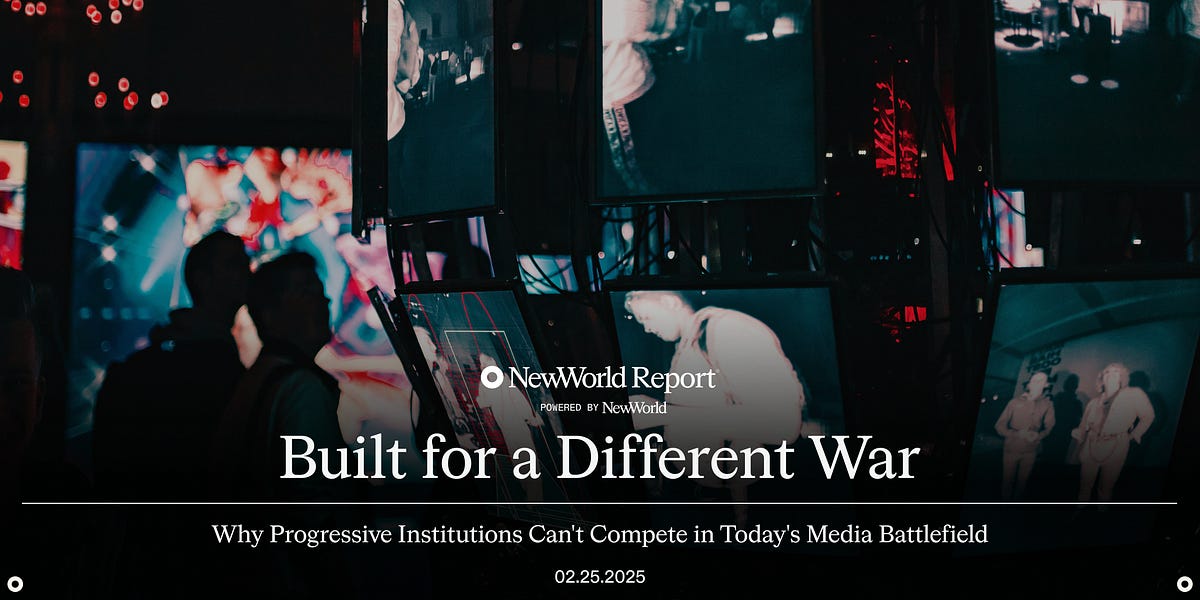
Built For a Different War

Theme: Climate & Ecology, Culture change, Economy, Election24, Philanthropy, Reactionary, Social Justice

Narrative work type: Narrative Strategy, Tactics

As the word ‘advocacy’ is banned from academic papers in the US, Banks reflects on how “the old pathways to influence are broken” with an instructive critique of progressives’ failure in “the battle for the nation’s conscience and culture”, as it continues to play by “the old rules.” “The progressive movement continues to pour resources into outdated influence tactics – broadcast advertising, performance marketing, media relations teams, policy shops, and think tanks – while the right has spent decades methodically building a sprawling ecosystem of decentralised (but powerfully coordinated) narrative infrastructure… Many progressives still think their problem is messaging: crafting the perfect slogan, landing the right talking point, tweaking the framing to be more ‘persuasive.’ But the real challenge is distribution.” Banks offers three steps for developing the essential “strategies that move the majority of people, on the platforms where they actually spend their time”.

Author: Andre Banks; New World Report

Are You Building Something?

Theme: Climate & Ecology, Culture change, Economy, Social Justice

Narrative work type: Narrative Strategy, Tactics

A straightforward argument that “lasting and meaningful change only happens when people come together for a shared purpose, when they deliberate together, and when they act together, even when the future seems unknowable and the road uncertain,” because “structural change is rooted in people, human beings, and the power we can create with each other when we find values we share, and our capacity to turn those values into sources of power.” Ganz emphasises how “organising is about enabling people to speak for themselves. It’s not a charity project. It’s a justice project,” and “it’s not enough to just have campaign after campaign” we have to be “building collective capacity…and you can’t do that without structure.” He sees that there has been “a whole lot of mobilising, but it didn’t turn into building infrastructure, into developing leadership. And unless you’re building at the same time you’re fighting, you wind up with nothing.”

Author: Marshall Ganz; SSRI

An Actual Plan to Beat Fascism

Theme: Climate & Ecology, Economy, Fascism, Social Justice

Narrative work type: Narrative Strategy, Tactics

“An incredibly practical guide to what you need to do”. Reflecting the spreading sentiment that ‘we’re on our own now’, Shenker-Osorio encourages people to get beyond “writing to their congressman” and instead, focus on “creating social proof locally” with various practical ways of demonstrating “that lots of people in your community feel the way you feel”, for example with signs, hats, t-shirts, or “painting of a barn.” She also notes that the fundamental rupture has not happened for most people yet, and when it does, there will be “extraordinary possibility”, but “we have to stop thinking that tinkering at the edges of the old ways that we have done things is going to yield a new result.” The journey beyond autocracy is one of “resistance, refusal and ridicule”, and means building a “strong, active in-yer-face labour community”, because ultimately “the future is made out of the decisions we take collectively.” Also see.

Author: Anat Shenker-Osorio; The Ink

Don’t Be Fooled. They Lie as Easily as They Breathe

Theme: Climate & Ecology, Economy, Reactionary, Social Justice

Narrative work type: Framing, Insight, Tactics

On how Trump and Musk’s mission “to destroy the restraints of regulatory democracy on unfettered capitalism, wherever it may have taken root in the world,” and their “preference for unregulated markets deliberately detached from democratic institutions” makes one thing clear: “capitalism is hostile to democratic processes and institutions.” Understanding this helps us recognise how, “slowly and skilfully over the last decade, the billionaire class has worked to delegitimise the slow process by which America’s democracy has widened the net of inclusion and diversity,” by “dismantling the process of inclusion and diversity” with “the propaganda campaign labelled ‘the culture wars’ — in reality a war between capital and labour.” A lesson for us: stop “actively negating the ‘culture wars’ framing” and instead celebrate “the wider democratic advance.”

Author: Ann Pettifor; System Change

Amygdala Hijack

Theme: Climate & Ecology, Economy, Social Justice

Narrative work type: Tactics

We are being forced into a ‘breakdown loop’, of burnout and ‘compassion fatigue’, by powers seeking to exploit the self-interest and ‘othering’ that such states provoke. “Fight-flight-freeze is ground zero for the toxic state of our politics, and it’s very much an equal opportunity affliction. None of us is immune. Everyone everywhere is freaking out. And so it is that something that starts in our private thoughts ripples out into the world, and helps to create the chaotic reality that we’re all inhabiting.” Evans asks “whether it’s possible to reverse the polarity of the cycle — so that a vicious circle becomes a virtuous spiral, and a breakdown loop becomes a breakthrough loop” which reorients us towards a positive, cooperative, hopeful ‘tend-and-befriend’ state. Evans encourages us to join in the “absolutely crucial step” of figuring this out, by learning to “untrigger”, “hold fast” and “let go”.

Author: Alex Evans; The Good Apocalypse Guide

The Psychology of Collapse

Theme: Climate & Ecology, Culture change, Economy, Social Justice

Narrative work type: Insight

A fascinating study of how “we’re wired to ignore the apocalypse.” Includes a look at the difficulty in countering ‘reactance’ (perceived threats to personal freedom), especially in highly individualised cultures; cultures which also make it difficult to care long-term when your brain literally sees your future self as a different person. We also learn that it’s not just Trump who has a principle of ‘never admitting you’re wrong’ — many of us do, thanks to ‘information disconfirmation’ and ‘selective perception’. We also tend to “express hostility or even aggression toward anyone who challenges the dominant structures,” shooting messengers thanks to ‘spontaneous trait transference’, where our brains conflate the threat with the person warning us about it. We’re also happy with lies provided we benefit from them, and think “it’s not cool to overreact”.

Author: Jessica Wildfire; Sentinel Intelligence

Breaking the Ouroboros and Ushering in New Possibilities

Theme: Climate & Ecology, Culture change, Economy, Social Justice

Narrative work type: Deep narrative, Tactics

An exploration of what it will really take to change. “What we have tried before and what we continue to centre, has not worked – cannot work – and so we need to transmogrify our efforts to be what is required in these days of pain and horror; to break the ouroboros and welcome in new possibilities.” Taylor reflects on how the change sector adopts the narrow logic of ‘one thing at a time’, applying it “to the complex and inherently interconnected nature of the crises we face, unintentionally creating an environment of competition…and missing the truth found in the convergence.” She suggests that the “common success metrics and data-proven strategies found in the campaigning of today could very much be a poisoned chalice, undercutting our efforts in the long term.” So “we need to create together different work which intentionally and explicitly has, as its focus, the need to respond to the crisis of values and the deep separation between human beings and nature,” and ultimately, “we must slow down”.

Author: Ruth Taylor; Culture Soup

Icebergs of the Heart

Theme: Climate & Ecology, Culture change, Economy, Social Justice

Narrative work type: Deep narrative, Tactics

An invitation to join in with designing a mapping tool for the foundations of better futures, which includes deep ‘ontological and mythological’ foundational shifts, e.g. from the ‘separation myth’ to a ‘relational ontology’, and from ‘linear time’ to ‘cycical and spiralic deep time’. “I have seen many, many ‘diagnosis’ icebergs before, but never one attempting to represent the more beautiful world our hearts know is possible… so I made these. It’s still – and will remain – a work in progress, so your insights are welcome with open arms and heart! What resonates? What’s missing? How do we birth this future together? Or is it already being birthed — by us and through us? What communities do we know already embody these worldviews? How can we learn from them?”

Author: Hajar Tazi; LinkedIn

The Struggle for Narrative Power in the Time of Audacious Racism

Theme: Economy, Social Justice

Narrative work type: Narrative Strategy

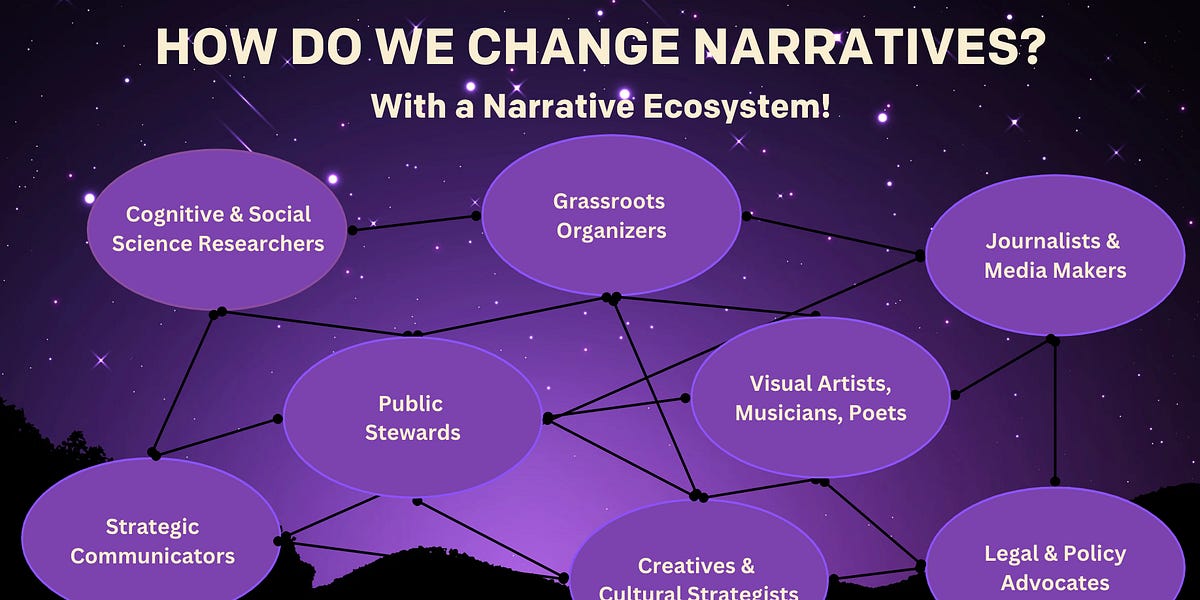
Quick guidance for an ecosystemic narrative strategy that “advances racial justice and brings people into solidarity with each other.“ Offering three focuses: “1. Keep telling OUR stories; 2. Grow the narrative ecosystem; 3. Stop reinforcing harmful dominant narratives,” with the recognition that “narrative work is long-term work. It requires boundless creativity, courage to experiment with new ways of telling powerful stories of equity and justice, and solidarity, resources and investments in growing the narrative infrastructure, and ecosystem. It requires hope and deep belief in our ability to win and bring about justice and joy in a world that seeks to erase our existence.” We are encouraged to begin “with the seed of a vision for a world where black, brown, queer, and immigrant communities are thriving. Let each of our imaginations be the soil from which this seed grows into reality.”

Author: Nikko Viquiera (Race Forward); Just Writing

Reclaiming Hope for Alternative Futures

Theme: Climate & Ecology, Culture change, Economy, Social Justice

Narrative work type: Tactics

You’ve heard of Three Horizons, Two Loops, Icebergs and maybe even MLP, but how about the Petals? This new model provides a timely update to systems change work, recognising that “all these models, without fail, position the radical as outliers – trying to break in – rather than centre-ing them as dominant forces of change, reinforcing their radicalism as oddity.” Responding to the “system-level dismissal or sniggering at those suggesting an alternative,” the model’s creators “wanted to convey emerging and alternative futures practitioners less like oddities or outliers and more like a new beginning at the heart of the model,” recognising that “what we call emergence is not often new at all, but rather being resurfaced or finally noticed by the mainstream.” Maybe “we’ve just been looking in the wrong place, blinded by the light of capitalism”, maybe what we need to replace an economic system “which continues to dominate despite having such an overwhelming and obvious incompatibility with human and planetary survival (let alone social and racial justice)” is already blooming.

Author: Jessica Prendergrast; The Onion Collective

  • « Go to Previous Page
  • Page 1
  • Interim pages omitted …
  • Page 3
  • Page 4
  • Page 5
  • Page 6
  • Page 7
  • Interim pages omitted …
  • Page 40
  • Go to Next Page »

Footer

Get the latest narrative insights, collected and delivered to your inbox, every two weeks

SUBSCRIBE

Questions, comments, or suggestions? Contact us

We are supported by:

The JJ Charitable Trust

Calouste Gulbenkian Foundation

  • Privacy Policy
We use cookies on our website. By clicking “Accept”, you consent to the use of the cookies.
Accept
Read our privacy policy for more details.
Manage consent

Privacy Overview

This website uses cookies to improve your experience while you navigate through the website. Out of these, the cookies that are categorized as necessary are stored on your browser as they are essential for the working of basic functionalities of the website. We also use third-party cookies that help us analyze and understand how you use this website. These cookies will be stored in your browser only with your consent. You also have the option to opt-out of these cookies. But opting out of some of these cookies may affect your browsing experience.
Necessary
Always Enabled
Necessary cookies are absolutely essential for the website to function properly. These cookies ensure basic functionalities and security features of the website, anonymously.
CookieDurationDescription
cookielawinfo-checkbox-analytics11 monthsThis cookie is set by GDPR Cookie Consent plugin. The cookie is used to store the user consent for the cookies in the category "Analytics".
cookielawinfo-checkbox-functional11 monthsThe cookie is set by GDPR cookie consent to record the user consent for the cookies in the category "Functional".
cookielawinfo-checkbox-necessary11 monthsThis cookie is set by GDPR Cookie Consent plugin. The cookies is used to store the user consent for the cookies in the category "Necessary".
cookielawinfo-checkbox-others11 monthsThis cookie is set by GDPR Cookie Consent plugin. The cookie is used to store the user consent for the cookies in the category "Other.
cookielawinfo-checkbox-performance11 monthsThis cookie is set by GDPR Cookie Consent plugin. The cookie is used to store the user consent for the cookies in the category "Performance".
viewed_cookie_policy11 monthsThe cookie is set by the GDPR Cookie Consent plugin and is used to store whether or not user has consented to the use of cookies. It does not store any personal data.
Functional
Functional cookies help to perform certain functionalities like sharing the content of the website on social media platforms, collect feedbacks, and other third-party features.
Performance
Performance cookies are used to understand and analyze the key performance indexes of the website which helps in delivering a better user experience for the visitors.
Analytics
Analytical cookies are used to understand how visitors interact with the website. These cookies help provide information on metrics the number of visitors, bounce rate, traffic source, etc.
Advertisement
Advertisement cookies are used to provide visitors with relevant ads and marketing campaigns. These cookies track visitors across websites and collect information to provide customized ads.
Others
Other uncategorized cookies are those that are being analyzed and have not been classified into a category as yet.
SAVE & ACCEPT