• Skip to primary navigation
  • Skip to main content
  • Skip to footer
Inter-Narratives Community

Inter-Narratives Community

  • Library
  • Sessions
  • Priorities
  • About
  • Subscribe

Social Justice

Library

Every two weeks we send out a newsletter full of narrative ideas and resources. We’ve catalogued these ideas by theme and category, which you can search below:


The Loudest Megaphone: How Trump Mastered Our New Attention Age

Theme: Climate & Ecology, Culture change, Economy, Reactionary, Social Justice

Narrative work type: Insight, Tactics

Hayes claims that we are now in “the attention age”, whose incentives “create a new model for public debate in which attention is its own end, to be grabbed by any means necessary”. It is a time when “amusement will outcompete information, and spectacle will outcompete arguments,” when democratic deliberation becomes “like trying to meditate in a strip club”. Trump is the master of this age, having hacked attention-age public discourse by “willing to court negative attention at the cost of persuasion.” So do we join in? “What good is persuasion if no one’s paying attention?” Do we have to accept that “you can be polite and civil and ignored, or you can fuck shit up and make people pay attention”?

Author: Chris Hayes; The Guardian, Long Read (adapted from ‘The Siren’s Call’)

So Now What?

Theme: Climate & Ecology, Economy, Fascism, Social Justice

Narrative work type: Deep narrative, Narrative Strategy, Tactics

An outline proposal for “a movement ecology, in the time of collapse and rising fascism,” which includes a detailed and compassionate reflection of the current context and its roots. We are encouraged to look “beyond frenetic action, which often targets, ineffectively, a multitude of symptoms, towards the possibility of enough collaboration and enough shared direction, focussed on addressing causes,” so that we might “sow seeds to support a profound transformation, over time.” This will involve developing community agency through preparation, recognising that “no one is going to save us, we need to prepare together”, and orienting toward a ‘third attractor’ – “a different and better way of being together”. Bradbrook offers ten suggestions of “what needs figuring out together” to build a “collective immune response”, and three opportunities to connect.

Author: Gail Bradbrook

Deep Structure: What Makes the Present

Theme: Culture change, Economy, Fascism, Social Justice

Narrative work type: Deep narrative

An encouragement to pay attention to root causes. “The political problem we face is not just about ‘capitalism,’ for this is only a politico-economic system that lies within the ontology. It is also the ontology itself – the broader environment or eco-system within which all other elements of the system exist, down to the microcosmic behaviour of the individual within that system – or the emission of a molecule of carbon… This ontological deficiency is one factor behind the rise of fascism: the failure to recognise and allow expression of fundamental aspects of what it is to be human, fostering a political system for instance that denies our basic need for autonomy and agency, which in turn provokes the intense anger which the Far-right is now busy exploiting.” The good news is that this “ontology can be altered, enriched, transformed both within ourselves and society. Merely changing our understanding, or indeed realising the importance of ontology, becomes a profound political act. This offers some grounds for hope for the possibility of fundamental change.”

Author: Carne Ross; Diplomatic Anarchist

From Fixers to Builders

Theme: Climate & Ecology, Culture change, Economy, Social Justice

Narrative work type: Narrative Strategy

“How do we get people of all political identities to willingly support social progress without compromising anyone’s values?” With a ‘New Narrative Form’ that “speaks the language of allies we’ve ignored,” and moves from the “narrative identity of being fixers of a broken world, to the next narrative of being builders of a better one.” To do this, we must “begin our thoughts and proposals with aspirational rather than problem statements.” Does it work? Apparently: “campaigns that have used next narrative approaches have already raised billions for progressive causes; engaged millions of people from across the political spectrum in institutional, legal, and historic progress; increased hope; and decreased stigma. Nothing theoretical about it.”

Author: Trabian Shorters; SSIR

The Lies We Tell Ourselves

Theme: Culture change, Economy, Social Justice

Narrative work type: Tactics

A reflection on “three of the most pernicious lies we tell ourselves about democracy, civic life, and community… Solidarity without proximity, civic renewal without economic renewal, and democracy without participation.” Pressler argues that “a genuine commitment to solidarity (in any form) requires a genuine commitment to proximity and mutuality”; that “our capacity for participation and membership is downstream of our capacity to exercise agency, and our capacity to exercise agency is downstream of our political, socio-cultural, and economic structures”; and that “professionalising” democracy, risks signalling “that these activities are only for some people and not for everyone else,” instead: “do the long-haul work of blurring the line between insiders and outsiders.”

Author: Sam Pressler; Connective Tissue

What Does Elon Musk Want?

Theme: Culture change, Economy, Social Justice

Narrative work type: Insight, Messaging, Tactics

A recent study finds that disinformation about refugees is rife, seemingly the result of reactionary attempts to falsely pin our economic woes on migrants, rather than inequality. Former top-trader turned inequality-campaigner Stevenson makes an interesting case here that this creates a problem for reactionaries: if anti-immigration parties actually deliver on their promises, then we won’t have any immigrants to point at and blame. As our conditions continue to worsen, despite lower immigration, we may then turn on the reactionaries. Which means the reactionary parties and their backers have to somehow demonise immigration, whilst actually increasing it. The Conservatives tried this in the UK, and they lost power. How will this play out elsewhere, and what can we do about it? Stevenson encourages his audience, who seem to be trapped in a zero sum winner-takes-all mindset, to recognise that “you need to change the rules of the game and that means working together.”

Author: Gary Stevenson; Gary’s Economics

What Can We Do?

Theme: Climate & Ecology, Culture change, Economy, Social Justice

Narrative work type: Stories, Tactics

In the first post of a new newsletter “about how to fight individualism and build collective power”, Blakeley laments that “the pandemic did not, as Indian novelist Arundhati Roy hoped, provide a ‘portal’ to a new world – it allowed imperialist states and big tech companies to consolidate control over our lives, while increasing support for far-right extremists.” She reflects on how “the idea that we have to fight to survive seems to have become commonplace”, and that by being encouraged to believe that “we are entirely on our own, and that interdependence and cooperation are signs of weakness”, hope is denied. But she sees a “contagious” sense of “collective empowerment” emerging among communities like Blaenau Ffestiniog in Wales, who are resisting this imposed zero-sum individualism to transform their communities. Blakeley goes on to realise that transformation “was only going to come from people trusting each other, supporting each other, and learning to work together.

Author: Grace Blakeley

Join the Citizen Collective

Theme: Climate & Ecology, Culture change, Economy, Social Justice

Narrative work type: Tactics

An invitation to join “a community of people leading and learning for a Citizen Future”. The idea is “to create a space for all of us who are trying to do this work, so we can learn from one another as we do it: sharing inspiration, asking questions, telling stories, and building community. It's free to join, and everyone's welcome.” Registration provides access to: “1. Fortnightly Community Check-in/networking calls; 2. Citizen Spotlight calls (fortnightly); 3. Citizen Workshop calls - the chance for anyone to pose a challenge or ask for help as the community meets to compare notes and share experiences (monthly); 4. The Citizen Collective Discord - the online community space with threads for sharing inspiration and questions and the opportunity to start or join discussion forums on any topic related to the work of building a Citizen's Future.” For more info see here.

Author: The Citizen Collective

Mini-Assemblies

Theme: Climate & Ecology, Culture change, Economy, Social Justice

Narrative work type: Tactics

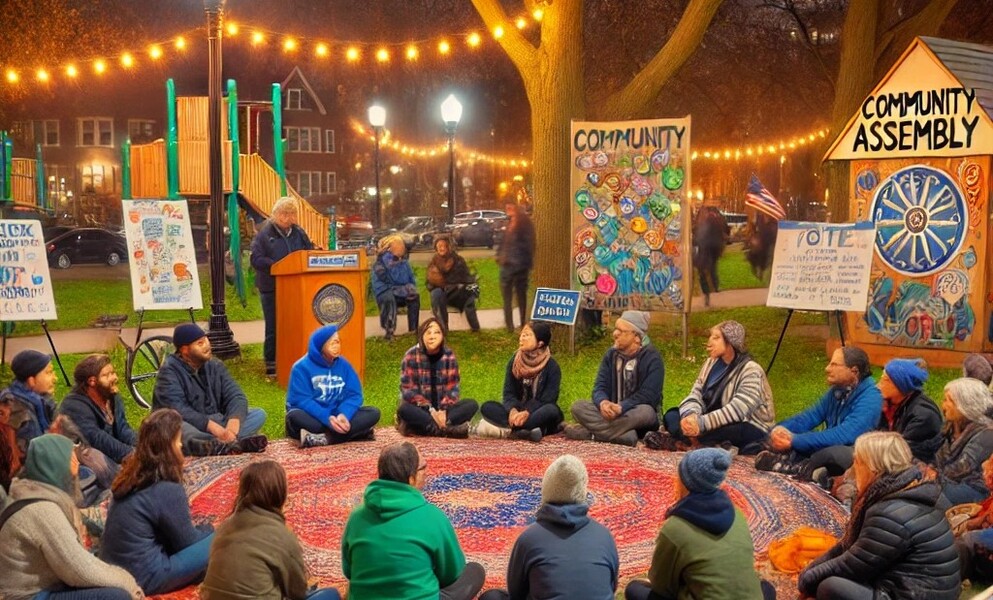
“Ready to shift the narrative? It’s time to stop panicking about the world’s problems and start changing how we approach them. Join us in creating a global movement built on love, listening, and collective action. Mini-assemblies are the gateway to a new kind of politics – one that’s not about power struggles, but about understanding, empathy, and real change. These assemblies are simple, informal gatherings where we listen to one another, discuss what's not working in our world, and work together to demand the change we deserve. With just a few hours of your time, you’ll be part of a powerful ripple effect that can spread across the world. Whether online or in person, in small groups or large, these mini-assemblies are your chance to make an impact, connect with like-minded people, and build momentum for the society we know we need… It’s time to listen, act, and create a world where love comes first. Let’s do this.”

Author: Action Network

How To Measure Narrative Change

Theme: Climate & Ecology, Culture change, Economy, Social Justice

Narrative work type: Narrative Strategy

The recording of a workshop offering a roadmap (25:00) and set of principles (56:00) to guide the measurement of narrative change work. “Whether working on a piece of art, a campaign, or power-building in local communities, narrative organizers are always exploring ways to measure the impact of their work. In this session, narrative change and evaluation experts share a radical, values-aligned framework that narrative practitioners and movement workers can use to measure narrative change.” Provides a full overview of a how to craft a narrative change evaluation strategy, as well as a reflection on frequently asked questions. Also see.

Author: Yewande O. Addie, David Hanson, Emily Melnick, Melody Mohebi, Annie Neimand; Rad Comms

Beyond The Broadcasting Model

Theme: Climate & Ecology, Culture change, Economy, Social Justice

Narrative work type: Messaging, Narrative Strategy, Tactics

“Foundations and nonprofits need to focus on community building rather than just pushing messages to an audience (or to that awful, imprecise word that ought to be banished to the jargon jar, “stakeholders”). It’s about engaging real people in meaningful ways to foster support and collaboration, which requires investing in genuine relationships and building sustainable communities based on shared values…This means moving away from mass messaging and toward face-to-face connections – listening, collaborating, and forming real partnerships… Trust is the foundation of communication, and in the field of communications-for-good, cultivating trust isn’t optional, it’s essential… Ultimately, the shift from broadcasting to relationship-building is more than just a tactical change. It’s a recalibration, driven by data and the evolving expectations of the communities we serve…we’d do well to remember that communication and community are inseparable and evolved from that common root.”

Author: Sean Gibbons, Tristan Mohabir; SSIR

The Populist Manifesto

Theme: Climate & Ecology, Economy, Election24, Social Justice

Narrative work type: Tactics

Shahid presents a deep assessment of the “zero-sum gridlock of two party politics” in the US, and offers a thorough plan for what the Democrats need to become next (could be a lesson for Labour too). “The Democratic Party has become trapped in a politics dominated by the upper middle class, where fighting for democracy and combating bigotry are framed more as moral performances of negative partisanship than as paths to real change… What remains is a politics of performative gestures and timid incrementalism – actions designed to placate elite donors and upper-middle-class voters while sidelining the working class and marginalised communities in the name of respectability… If Democrats want to reclaim their position as the party of working people, they need to stop hedging and start confronting the power structures that define inequality… To govern in the people’s interest, you first have to be willing to take on those who profit from their suffering… The next DNC Chair must rebuild the party around a simple idea: Democrats win when they are the party of working-class people of all backgrounds.” Also see.

Author: Waleed Shahid; The.Ink (paywall)

  • « Go to Previous Page
  • Page 1
  • Interim pages omitted …
  • Page 5
  • Page 6
  • Page 7
  • Page 8
  • Page 9
  • Interim pages omitted …
  • Page 40
  • Go to Next Page »

Footer

Get the latest narrative insights, collected and delivered to your inbox, every two weeks

SUBSCRIBE

Questions, comments, or suggestions? Contact us

We are supported by:

The JJ Charitable Trust

Calouste Gulbenkian Foundation

  • Privacy Policy
We use cookies on our website. By clicking “Accept”, you consent to the use of the cookies.
Accept
Read our privacy policy for more details.
Manage consent

Privacy Overview

This website uses cookies to improve your experience while you navigate through the website. Out of these, the cookies that are categorized as necessary are stored on your browser as they are essential for the working of basic functionalities of the website. We also use third-party cookies that help us analyze and understand how you use this website. These cookies will be stored in your browser only with your consent. You also have the option to opt-out of these cookies. But opting out of some of these cookies may affect your browsing experience.
Necessary
Always Enabled
Necessary cookies are absolutely essential for the website to function properly. These cookies ensure basic functionalities and security features of the website, anonymously.
CookieDurationDescription
cookielawinfo-checkbox-analytics11 monthsThis cookie is set by GDPR Cookie Consent plugin. The cookie is used to store the user consent for the cookies in the category "Analytics".
cookielawinfo-checkbox-functional11 monthsThe cookie is set by GDPR cookie consent to record the user consent for the cookies in the category "Functional".
cookielawinfo-checkbox-necessary11 monthsThis cookie is set by GDPR Cookie Consent plugin. The cookies is used to store the user consent for the cookies in the category "Necessary".
cookielawinfo-checkbox-others11 monthsThis cookie is set by GDPR Cookie Consent plugin. The cookie is used to store the user consent for the cookies in the category "Other.
cookielawinfo-checkbox-performance11 monthsThis cookie is set by GDPR Cookie Consent plugin. The cookie is used to store the user consent for the cookies in the category "Performance".
viewed_cookie_policy11 monthsThe cookie is set by the GDPR Cookie Consent plugin and is used to store whether or not user has consented to the use of cookies. It does not store any personal data.
Functional
Functional cookies help to perform certain functionalities like sharing the content of the website on social media platforms, collect feedbacks, and other third-party features.
Performance
Performance cookies are used to understand and analyze the key performance indexes of the website which helps in delivering a better user experience for the visitors.
Analytics
Analytical cookies are used to understand how visitors interact with the website. These cookies help provide information on metrics the number of visitors, bounce rate, traffic source, etc.
Advertisement
Advertisement cookies are used to provide visitors with relevant ads and marketing campaigns. These cookies track visitors across websites and collect information to provide customized ads.
Others
Other uncategorized cookies are those that are being analyzed and have not been classified into a category as yet.
SAVE & ACCEPT